
-
Waiting on the Lord
Stands against Worry.
-
But they that wait upon the Lord shall renew their strength; they shall mount up with wings as eagles; they shall run, and not be weary; and they shall walk, and not faint.
Isaiah 40:31 -
Wait on the Lord: be of good courage, and he shall strengthen thine heart: wait, I say, on the Lord.
Psalms 27:14 -
The Lord is good unto them that wait for him, to the soul that seeketh him. It is good that a man should both hope and quietly wait for the salvation of the Lord.
Lamentations 3:25-26 -
Waiting here is not sitting still. All three passages put it next to strength, courage and hope — it is something you do.
-
-
Worry
-
Be careful for nothing; but in every thing by prayer and supplication with thanksgiving let your requests be made known unto God. And the peace of God, which passeth all understanding, shall keep your hearts and minds through Christ Jesus.
Philippians 4:6-7 -
Take therefore no thought for the morrow: for the morrow shall take thought for the things of itself. Sufficient unto the day is the evil thereof.
Matthew 6:34 -
Both answers redirect rather than argue: one to prayer, the other to the size of a single day.
-
Waiting on the Lord
by matthieu · 19 August 2026 · updated 20 August 2026
What does the Bible mean by waiting on the Lord?
The word sounds passive, but Scripture never uses it that way. Wherever the phrase turns up it is attached to strength, to courage, to hope — those who wait are renewed, strengthened, sustained. Waiting on the Lord is something you do; it is a practised posture of active trust, not the absence of action.
 Close
Close
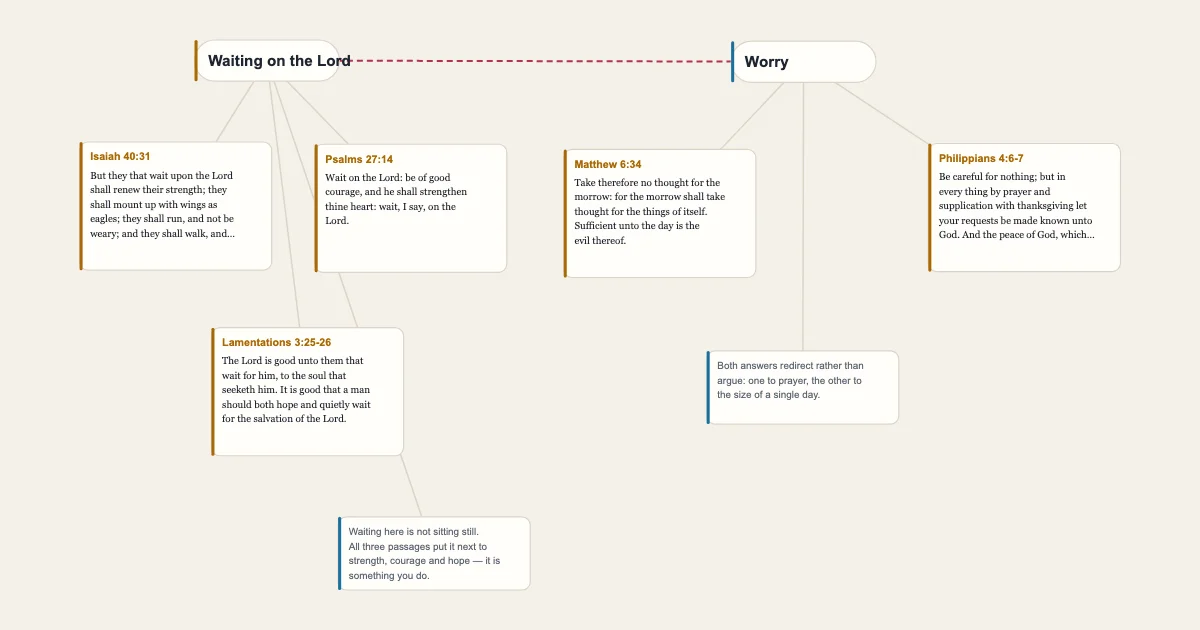
So the map puts waiting in the middle, and hangs three passages around it. Isaiah 40:31 says that they that wait upon the Lord shall renew their strength; they shall mount up with wings as eagles. Psalm 27:14 gives the instruction twice in a single verse: wait on the Lord, be of good courage, and he shall strengthen thine heart. Lamentations 3:25-26 adds that the Lord is good unto them that wait for him, to the soul that seeketh him; and that it is good that a man should both hope and quietly wait.
Read together, the three correct the picture most of us carry around. None of them describes sitting still. Each one sets waiting next to an active word — renewing, mounting up, taking courage, hoping, seeking. The waiting these writers describe has direction. It is closer to the way a watchman waits for the morning than to the way a passenger waits for a delayed train.
Then there is a second concept on the map: worry, connected to waiting as its counterpart, with Philippians 4:6-7 standing under it (be careful for nothing; but in every thing by prayer and supplication with thanksgiving let your requests be made known unto God). And here the thing becomes interesting, because worry and waiting turn out to be answers to the same situation. Both respond to a future you cannot control. One hands the outcome over and grows quiet; the other rehearses the outcome and grows loud.
Seeing the two side by side is what a map is for. A list of verses about waiting would give you each text on its own, one after another, and nothing else. The map shows you the structure: three passages agreeing about what waiting is, one concept standing opposite it, and a note in your own words recording what you saw. That structure is also what makes the passages easier to keep. When you know where a verse belongs, and what it answers, the words have something to hang from.
The passages, in reading order
Read next
- More mind maps that work with Psalms Other maps that open the same book, with the passages each one uses.
This mind map can be learned by heart
Every passage climbs nine rungs, from recognising it among others to writing it out from the reference alone. A passage that keeps slipping stops being tested and gets built up instead — seven techniques, one at a time.
- 1. Which passage
- 2. Which concept
- 3. Which one was it
- 4. In order
- 5. Next word
- 6. Tap the gaps
- 7. Type the gaps
- 8. First letters
- 9. From memory
You get your own cards to change. Passages in translations we hold no licence for, and words the author pasted themselves, come across as references.